Author: Arturo Gutierrez – RPA Engineer
INTRO
Indeed many people wonder how industry giants such as Netflix, Unilever and ANZ Bank have been able to improve their employees’ professional growth, increase their profits and optimise their internal processes. Many point out that their development has been due to their financial muscle or the ideas of someone who has knowledge from other planets.
Nothing could be further from the truth. The truth can be found in a much simpler and devastatingly effective point, such as managing daily activities effectively and improving employees’ skills. This is known worldwide as “profit per employee”, a new measure that leaves behind obsolete topics such as ROI and begins to qualify a company by the value that an employee provides over time.
Now, the question is, how can we improve these rates so that the company is more like the current tycoons that are generating millions of dollars a month?
What can we invest in to obtain the desired “profit per employee” that everyone is talking about, or better yet, as employees complain about the repetitive tasks they are assigned, how can we prevent them from getting bored with their work and ending up leaving the company?
The answer to these questions is found in the term Intelligent Process Automation or IPA: the digital transformation enabler, also known as IA (Intelligent Automation) or Cognitive Automation, which is based on the integration of technologies such as Artificial Intelligence and RPA robotics for the automation of organisational processes.
TACKLING THE MYTHS OF IPA
MYTH 1: IPA is going to kill jobs
Today’s companies need fewer employees, which should no longer be seen as negative. Several studies indicate that more people die of stress or exploitation at work than in wars and terminal illnesses. More than 75% of people are dissatisfied with their jobs because they are repetitive and tedious. It is essential to see an alternative to these jobs that are destroying employees’ professional careers and to see new business strategies that drive “profit per employee” in acquiring new skills and technologies.
69% of workers expect that through automation, they can be more productive in their main professional activities, and 86% of employees think that the use of automation in the workspace drives them to learn about issues of value to the organisation, the fact that fewer employees are needed should be seen as an opportunity for professional growth in the collaborators.

Stable Diffusion generated image of robots working
What IPA can offer in the long term is known as the “Triple A artefact”, which is all the benefits that can be achieved through the implementation of technologies in the processes, divided into three critical factors:
- Automation: Repetitive tasks in the processes must be recognised and automated.
- Augment: Understand the processes’ behaviour over time and their benefit to the company through data analysis tools.
- Abandon: eliminate activities that do not add value to the companies and reflect an unnecessary expenditure of time and effort.
The following image shows how IPA can improve the performance of those repetitive activities that occur in companies daily and increase the “Profit per employee”.
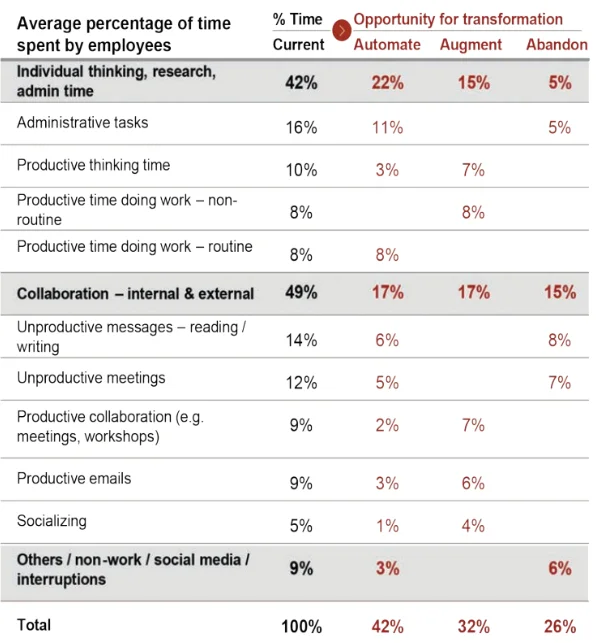
Profit per employee improvement with automation
As can be seen, many repetitive and low-value activities can be automated through IPA, and tools can be generated to help workers improve their performance and professional growth.
MYTH 2: There is insufficient capital or knowledge to implement this technology
To carry out a good development of IPA: the digital transformation enabler in companies is necessary to know the stages of transition and digital transformation that must be adopted to have an exponential value in the business over time. If these three phases are followed with commitment, patience and discipline, it is possible to reach the technological development that business giants have so far.
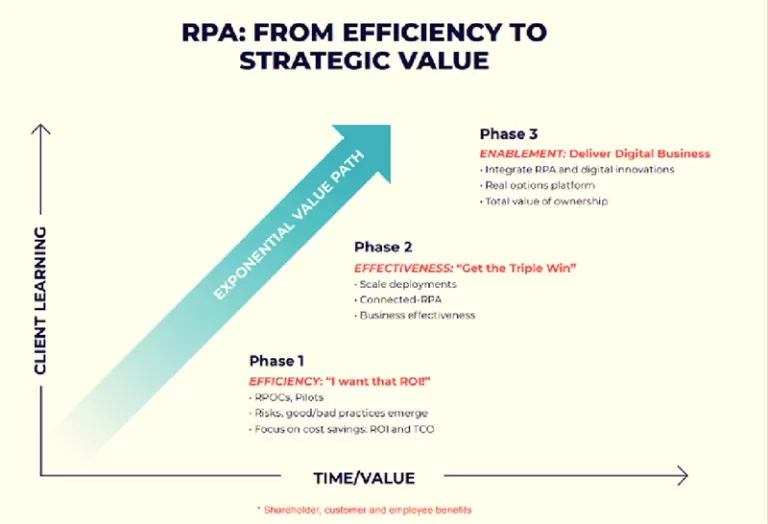
RPA strategic value phases
Phase 1: Efficiency
Efficiency is needed for automating and identifying through RPA all those repetitive and routine processes currently in the company.
The potential of this technology is not being exploited. RPA generates an ROI between 30-200% in the first 18 months, and in terms of progress in 2021, the RPA market was 3.5 billion USD; it is expected to grow by 40% per year.
But the integration of RPA at this point is not enough; there are many challenges of scalability, strategic investments and expected benefits that a second phase must handle.
Phase 2: Effectiveness
Strategies for scaling this technology over time are being developed. Customers own between 1 and 50 robots. Few have scaled from 51 – 100, and methods are expected to improve the transition from phase 1 to phase 2. However, there are still processes that RPA cannot carry out due to their complexity and data types. For them, it is crucial to scale RPA to an enterprise level and create intelligent automation through a third phase.
Phase 3: Enabling
This is the last phase and where IPA generates its greatest expected benefits. For this phase to bear fruits, it must consider the automation of mid-office processes, back office and customer-facing activities, handle unstructured data, analytics and probabilistic decisions and take into account that most of the challenges are organisational and managerial.
Companies must become digital businesses, where the great value lies in creating a platform of digital options that provide businesses with flexibility, adaptability, strategic choices and resilience at low cost.
As reflected in the explanation of each phase, it is necessary to go from less to more in these integrations. It is advisable to start by identifying through a diagnosis the repetitive processes that can be automated, see how more automation can be scaled at the enterprise level (having more software robots) and finally, carry out a phase of digital transformation where the application of technologies such as artificial intelligence and RPA (IPA) go hand in hand in complex processes that allow obtaining statistics and generate tools to complement the work of employees.
MYTH 3: IPA and Digital Transformation does not apply to my current area and type of business
There are different methods of applying IPA in the processes; the most relevant and which are in a phase of study and application in Equinox AI Lab are the following:
-Document Understanding:
It is known as intelligent document processing. Its main objective is to process documents of different formats and obtain relevant information by integrating two technologies, artificial intelligence and RPA.
This technology is applicable to different industry sectors processing documents such as invoices, receipts, purchase orders, utility bills, landing invoices, passports, and licenses, among other documents that RPA alone cannot extract due to the complexity of their structure and context.
Some examples applicable to specific business areas may include the following:
- Financial services and insurance: invoices, IRS Forms, loan applications, mortgage processing, account opening and customer onboarding, claims, vendor onboarding, and processes related to regulatory compliance.
- Human Resources: employee onboarding, resume screening and HR file processing.
- Manufacturing: sales order processing, customer orders and shipment processing.
- Public sector: migrations, school applications and passport applications.
- Health: medical forms, medical invoices, medical records and medication prescriptions.
-Here we have some tips for good intelligent document processing:
- Have a proper flow for the different processes. It is suggested to use the following.

RPA workflow for company’s processes
- Taxonomy is the understanding of the document. In this phase, it is important to define the types of documents and the fields to be obtained through the extraction.
- Digitalise: convert the documents through OCR into machine-readable data.
- Classify: classify and separate the files into document types.
- Extract: extract the information from the documents.
- Export: export the data for later use in other processes.
- Acquire a balanced variability, and obtain the appropriate number of documents for training the model. In this case, multiplying the number of fields to be extracted by 25 is essential.
- Generate a clustering algorithm; choose ten copies of each format and no more than ten if there are many formats.
NLP + RPA
Natural Language Processing (NLP) is a technology that allows the analysis of large amounts of data in text or audio, allowing the computer to interpret and understand human language based on Machine Learning.
For the correct implementation of NLP models, especially in the case of IPA, it is vital to establish the objective, quantity and quality of data you have. The training and evaluation files will be generated according to the model and the objective.
Usually, the input data can be entered with CSV or JSON files, and the output will be in JSON format. These models use different pattern identification techniques and can be used in the following:
- Classifying individual data or text: for example, to identify whether a text has a positive or negative meaning.
- Extracting entities by category: as in the case of scientific reports from which, it is necessary to extract the chemicals that are mentioned and classify them by type.
CONCLUSIONS
Working with IPA: the digital transformation enabler allows us to demystify certain beliefs that do not allow companies to reach the digital transformation they want to have.
It can be observed that increasing the “Profit per employee” through a triple A artefact benefits not only the professional career of workers but the company’s progress, abandoning those activities that represent a waste of time and focusing on the development of technological tools for improving processes.
It is not necessary to have significant capital and knowledge of another world to apply this technology, just be patient and rely on the three phases of digital transformation “efficiency”, “effectiveness”, and “enablement”. IPA is scalable and applicable to different business areas, and it is hoped that, through this article, the readers will be able to understand the impact that IPA is generating in companies and how it can be helpful to benefit them positively.
REFERENCES
Intelligent Automation – Learn How to Harness Artificial Intelligence to Boost Business & Make Our World More Human (Libro)
Becoming strategic with Intelligent Automation – leslie willcoks
UiPath document Understanding – Documentacion Uipath
Document Understanding: Cómo prepararse para una implementación exitosa – See Document Understanding: Cómo prepararse para una implementación exitosa at UiPath Colombia
TextClassification – Documentación de UiPath

Arturo Gutierrez – RPA Engineer
EQUINOX
what’s ai?
Discover what is AI and how it will become revolutonary in the industry